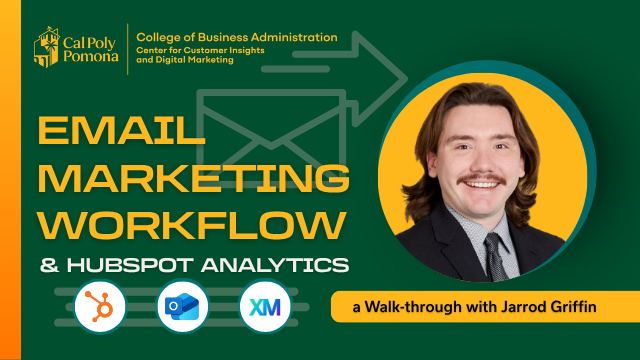
I teach the way I work: the person leaves able to do the thing, on their own data, with a recording for the second time. Most of what's here was built for Cal Poly Pomona's Center for Customer Insights and Digital Marketing, where I designed and delivered the workshop series below across two stints.
Each page has the learning outcomes, the skills covered, and the recorded session. Several are used in master's-level coursework. CCIDM's write-up of the series ↗
The same sessions, on your data and your tools, for the people who will actually do the work.
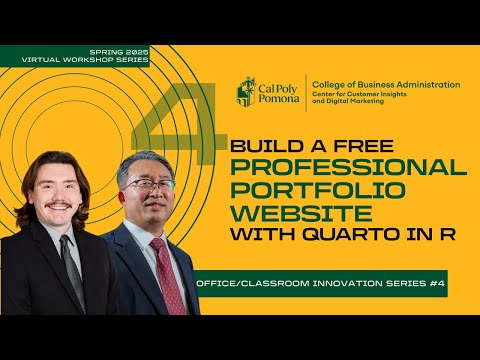
In one session, people who had never built anything left with a live site that could take orders. It started as a breakout session for business leaders at the CBA Innovation Symposium, then I was invited back as a guest lecturer to teach it as a full classroom workshop.
Panels, forums, and symposium sessions, most of them at Cal Poly Pomona. Workshops are listed above. The research behind the 2019 and 2020 entries is on the academics page.
Learning and becoming by doing. Students and staff work on real, industry-shaped tasks rather than listening: building a dashboard, setting up tracking on a live site, producing a report someone will actually read. They leave with a skill and a piece of work they can show, and the session is designed so that people with different backgrounds and ways of learning can all get there.
My teaching philosophy in digital marketing is grounded in the conviction that education must be an active process of learning and becoming by doing, treating students as emerging professionals rather than passive listeners.
This foundation draws on established learning theory: Vygotsky's social constructivism frames the classroom as a collaborative community; Gardner's multiple intelligences honors the diverse ways students understand and process information; and adult motivational theory shows that learners thrive when given autonomy and real-world relevance.
These theories drive my instructional approach. I prioritize project-based learning and authentic assessment over standardized exams. Students tackle hands-on, industry-aligned tasks such as developing data-driven marketing campaigns, building analytics dashboards, and consulting for live clients, so they leave with tangible skills and professional portfolios that translate directly to their careers.
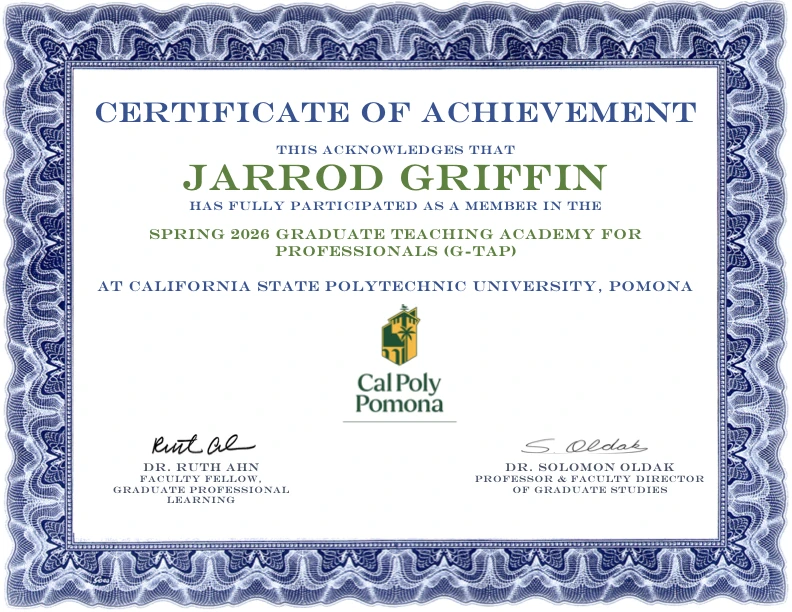
I completed Cal Poly Pomona's Graduate Teaching Assistant Program, a structured pedagogical training program led by Dr. Ruth Ahn, covering evidence-based instructional design, student-centered teaching, and equitable classroom practice. The teaching demonstration, developed with fellow graduate students, is where the planning behind an inclusive session became concrete for me: anticipating how students from different backgrounds read a question, and designing the lesson to adapt to them rather than the other way around.

A breakout session at Cal Poly Pomona's CBA Innovation Symposium, April 2026, on how AI tools change the work across the digital marketing funnel, from content production and audience targeting to conversion measurement and reporting. It was my second year presenting at the symposium; in 2025 I ran the session on building a website with Quarto.
Where it went next. The session was picked up by the graduate program: I was invited back as a guest lecturer to run it as a full classroom workshop, and students, none of them developers, left with live, professional-looking websites that could take orders. Use the arrows or keyboard to navigate the deck. Press F for full screen.