I left, and it kept working.
Center for Customer Insights & Digital Marketing, Cal Poly Pomona · 2024–2026
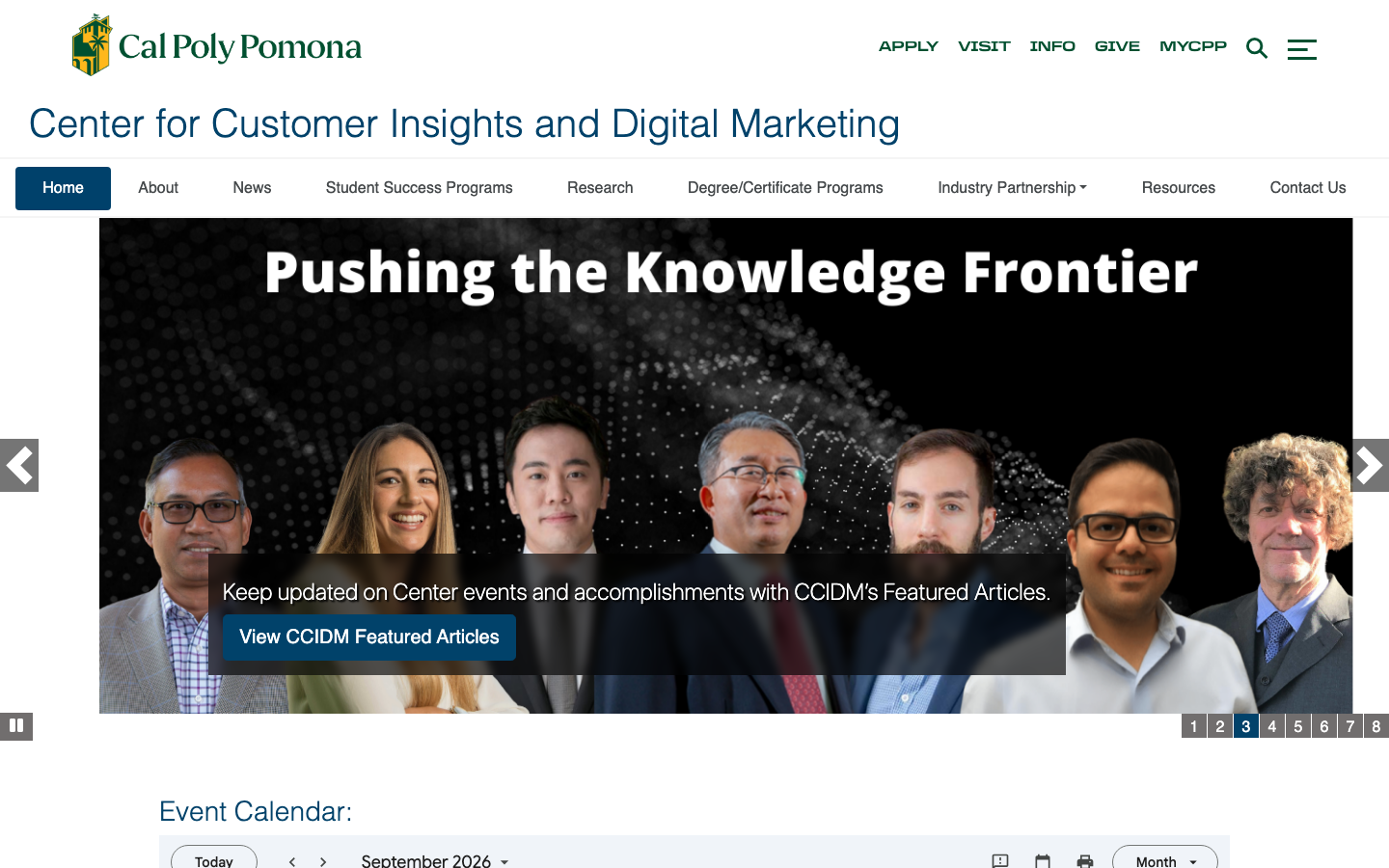
The situation
CCIDM is Cal Poly Pomona’s digital marketing research and outreach center. It runs a website, a contact database, an analytics program, a workshop series for graduate students, and a steady flow of reports and events. It had no technical staff. Every one of those things was done by hand, by whoever was around, in a browser.
I joined as a student analytics assistant. Within a year the job was, in practice, the center’s technical operations: seven domains across about ten repositories. The job description never caught up.
What I built
The website, made operable. The site lives in an enterprise CMS that was edited click by click. I built a command-line tool with 31 commands and a small desktop editor, so page changes, bulk edits, and audits take seconds. Every edit goes through the CMS’s own review step before it touches the live site, which is what makes it safe to hand to an AI tool.
The contact database, made clean. Twelve separate lists. Campus interest lists, faculty and staff, clients, alumni, guest speakers, the website mailing list. Merged, de-duplicated, and moved into HubSpot. That one project unlocked email analytics and marketing automation the center had never had. Alongside it, a converter that turns survey forms into CRM forms, and drafting tools for social and email.
The numbers, made visible. A GA4 to BigQuery export with SQL views. A dashboard the director could open. A tag management rollout plan, a performance app, a YouTube channel analysis with a procedure the team could repeat, and the center’s annual report built from data instead of memory.
The workshops. Hands-on sessions for MSDM graduate students. R and Quarto, Shiny, GitHub, taming Google Analytics, production-ready marketing reports, building a website with AI tools. Across both my stints at the center: thirteen workshops, 19,000+ views on the recordings, and a series adopted as a prerequisite for a graduate course.
The templates and tooling. A branded presentation template, an internal R package, document-to-web conversion scripts, flyer kits, and course modules. The unglamorous things that make the next report take an hour instead of a day.
What changed
Manual, person-dependent work became documented, scriptable systems. Multi-hour content audits became a command. The CRM went from twelve spreadsheets to one source of truth. The director could see the center’s numbers without asking anyone.
And then the part most technical work never gets. I left, and it kept working.
The handoff, and how the AI part works
Eight days before my last day I built a handoff site for whoever came next. It is written for two readers at once, a person with a browser and a campus login, and an AI tool. That is the design I now bring to every client.
- Level one is the job in a browser. The everyday tasks, with recorded walkthroughs. No code, no setup. Someone can do real work on day one.
- Level two is the tooling. Six playbooks, one per system. Every task is written twice: the plain-English request you would type to an AI tool, and the exact command a person runs. Then what to check afterward, and what never to do.
- Nothing is guessed. Every place where knowledge lived only in my head was marked as a gap, then answered or recorded as unresolved before I left. A confidently wrong instruction is worse than a visible hole.
That is what “AI, used like a tool” looks like in practice. The AI path is the fast path. The human path is always there. Every action can be reviewed. Nobody is locked in.
What the center can do now
Run the website, the CRM, the analytics, and the workshop program with a student and a browser, and speed any of it up with the tooling when they are ready. The systems do not depend on me. They do not depend on any particular AI subscription either.